


Sometimes a maison enters a boutique before one can fully understand it.
Chapel Factory arrived at KŌDŌ in a briefcase. It was brought by Marco, who at the time was heading the company distributing it in Italy, when he came to visit us with his mother.
Over a coffee, he opened the briefcase and, before beginning, said something I still remember:
“These are not easy perfumes. But if the customer understands their story, they will fall in love with them.”
Such a preamble almost inevitably prepares one for something dark, solemn, and imposing. The first perfume I tried, however, was Baptisma.
And every expectation was overturned.
An incense different from what we imagine
When talking about incense in perfumery, it is easy to think of somber, opulent fragrances, or ones necessarily aimed at an imagined Orient.
Baptisma told a completely different story.
The maison presents it as a baptismal water capable of evoking the scent of childhood. Bergamot, verbena, and ginger introduce a heart of neroli, jasmine, and milk; in the base, incense meets musk and white musk.
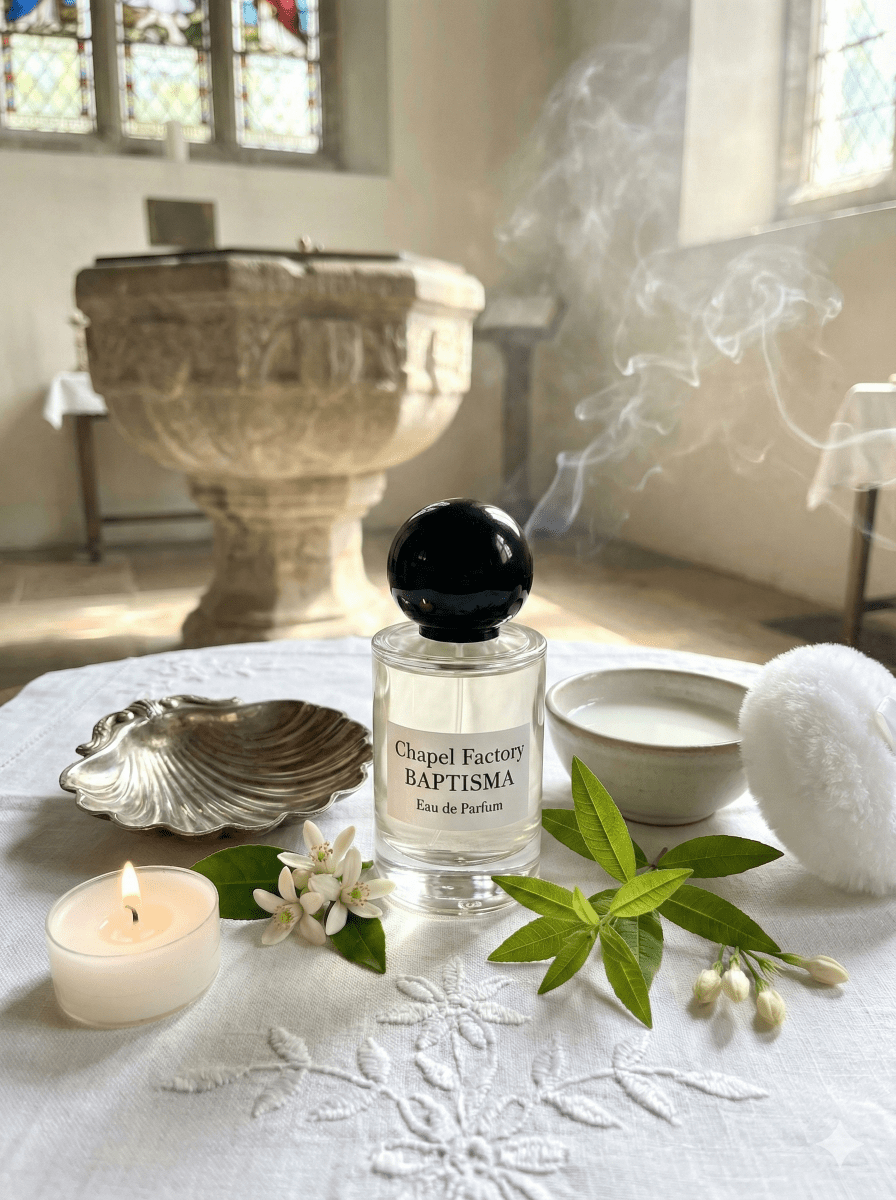
It reminded me of something candid, clean, and light. A baptismal font, a white light, the sensation of freshly washed skin. Everything the opposite of what I expected after that preamble.
And it was precisely this contrast that helped me understand Chapel Factory.
I was not looking at a series of perfumes built to repeat the same idea of incense. I was looking at a maison that had chosen incense as a vocabulary, using it every time to tell something different.
The vision of Anaïs Biguine
Chapel Factory was born in 2020 from the vision of Anaïs Biguine, already the creator of Jardins d’Écrivains.
History, literature, religions, and their symbolic languages permeate her work. With Chapel Factory, this interest focuses on a material that has accompanied humanity for centuries.
On its website, the maison defines incense as a universal language and describes the project as a free dialogue between spiritual heritage and modern creation.
It is an important distinction.
Incense is not used solely to evoke a religious place, nor to build a generic mystical atmosphere. It becomes a key through which to observe images, rituals, memories, works of art, and landscapes.
Sometimes it is luminous. Other times it is dry, mineral, balsamic, floral, or immersed in woods. It can speak of innocence, freedom, solitude, nature, or travel.
Reducing Chapel Factory to the definition of “incense perfumes” would mean missing almost everything else.
A material we already know
In perfumery, we are often led to seek distant materials, exotic names, and ingredients that seem to belong to unreachable worlds.
We forget that some scents are already in our homes and in our memory.
Incense crosses different traditions. It has been used in rites, gestures, and collective moments that change from one culture to another, but which share the desire to modify the atmosphere of a space and attribute meaning to it.
That is why its scent can feel familiar even when we do not know how to describe it. Before becoming a note to seek within an olfactory pyramid, it can be the memory of a place, a ceremony, a room, or a moment.
Chapel Factory starts from this familiarity and moves it elsewhere.
From Baptisma to Heresy: the same material, different stories
Baptisma belongs to the first core group with which Chapel Factory introduced itself in 2020, along with Heresy and Holy Stick.
Already in these first creations, incense changes its function continuously.
In Baptisma, it is enveloped by white flowers, milk, and musk. Its presence is delicate, powdery, almost transparent.
Heresy follows a different direction. The name recalls heresy in its ancient meaning of a school of thought. The maison associates it with the luxury of feeling free and the long journey of incense across the Arabian Peninsula. Pepper, cedar, sandalwood, violet, vetiver, patchouli, and guaiac wood build a drier, woodier, and more decisive landscape.
Therefore, it is not the incense that imposes a fixed character on the perfume. It is the story that indicates which form it should take.
When an image becomes a perfume
One of the clearest examples of Chapel Factory’s creative method is Cornette.
The maison links it to the portrait of a woman painted in 1435 by Rogier van der Weyden. The starting point is not only the subject of the work, but its spectral white, the gaze, and the silent strength of the image.
That whiteness is translated into an opaque, chalky, and mineral incense, crossed by a vegetal musk.

The interesting aspect is not to establish whether Cornette “smells like” the painting. An image, naturally, does not possess an objective scent.
The perfume instead proposes an interpretation: it takes color, material, atmosphere, and visual tension and transforms them into an olfactory experience.
This is where perfumery stops being merely a succession of notes and becomes a narrative.
Eliminating the superfluous
Another element that struck me was the choice to use essential packaging.
The feeling was that the maison wanted to eliminate what was not needed to bring the focus back to the contents of the bottle. No spectacular construction is necessary to justify the perfume before even smelling it.
It is a choice that, personally, I find consistent with the project: the imagery is rich, but the object does not need to shout about it.
The narrative is not entrusted to a monumental casing. It truly begins when the perfume is tested.
Why Chapel Factory joined KŌDŌ
I chose Chapel Factory because I love the stories that live behind perfumes, and here every creation has something to tell.
I do not yet have a definitive answer as to which are the three perfumes that best represent the maison. Perhaps that is precisely the point: to choose only three would mean looking for a synthesis where the interesting part is the variety of interpretations.
Personally, I use Oud Pagode, Heresy, and Eau d’Épine. Three different perfumes, which I wear not because I simply want to “smell like incense,” but for the images and sensations they manage to open up.
I have not yet had the pleasure of meeting Anaïs Biguine in person. I hope that happens soon.
In the meantime, Chapel Factory continues to remind me of the first impression of Baptisma: a material I thought I knew and which, within a few moments, showed itself to be completely different.
Perhaps that is what a good perfume should do.
Not confirm what we expect, but offer us another way to look at it.
Discover Chapel Factory at KŌDŌ
The Chapel Factory collection brings together perfumes for the person and creations for the home, each built around a different story.
Explore Chapel Factory at KŌDŌ